The Pig dice game: rules, strategy and when to stop rolling
Pig needs one die and one big decision: roll again or stop? Here are the rules, the simple math that tells you when to stop, and how to win the endgame.
How to play Pig
Pig is a classic push-your-luck dice game. Each turn you keep rolling to build up points, and you can stop whenever you like to keep them. Roll a 1, though, and you lose everything you built that turn. It takes a minute to learn, works for any number of players, and needs only one six-sided die and something to write the scores on.
- Players take turns. On your turn, roll the die.
- Rolling 2, 3, 4, 5 or 6 adds that number to your turn total. You can then roll again or stop.
- If you stop (often called "holding" or "banking"), your turn total is added to your score and the die passes on.
- If you roll a 1, your turn total is lost, nothing is added to your score, and your turn ends.
- The first player to reach 100 points wins.
That's the whole game. Every turn is the same question: is the next roll worth the risk to the points you already have?
Pig strategy: why 20 is the magic number
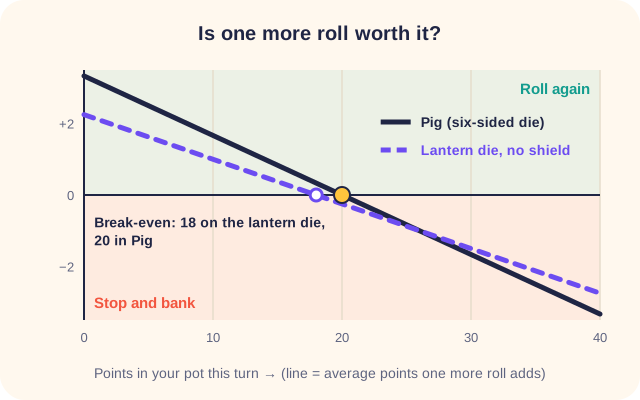
You don't need to guess. A little arithmetic tells you how much one more roll is worth on average:
- 5 times in 6 you roll 2 to 6. Those average 4 points, so this side is worth about 4 × 5⁄6 ≈ 3.3 points.
- 1 time in 6 you roll a 1 and lose your whole turn total. With 12 points at stake that costs 12 ÷ 6 = 2 points on average; with 30 at stake it costs 5.
The two sides balance when your turn total is 20: 20 ÷ 6 ≈ 3.3. Below 20, rolling again adds points on average. Above 20, it loses them. That's where the famous rule comes from: keep rolling until your turn total reaches 20, then stop.
Endgame: when to break the 20 rule
Points per turn isn't the real goal. Winning is. Near the end of the game, the score matters more than the average:
- Stop as soon as you can win. If your turn total takes you to 100, stop at once, even if it's only 6 points.
- Far behind? Take bigger risks. If an opponent is close to 100, safe 20-point turns won't catch them. Keep rolling for a bigger turn.
- About to lose? If your opponent will very likely win on their next turn, go for 100 in this one. Stopping early just hands them the win.
- Comfortably ahead? Stop a little earlier than 20 and make your opponents take the risks.
Pig variations to try
- Shorter games: play to 50 instead of 100 with young children.
- Last turn for everyone: a common house rule gives every other player one final turn after someone reaches 100. It takes away the advantage of going first.
- Two-dice Pig: in a popular version you roll two dice. A single 1 ends your turn with nothing added, and double 1s wipe out your whole score.
- A different die: change the faces and the strategy changes too. That's exactly what Lucky Lanterns does.
Lucky Lanterns: Pig with a lantern twist
Lucky Lanterns is a free online push-your-luck game inspired by Pig. Instead of a six-sided die you roll an eight-sided lantern die with two Gusts, the numbers 3 to 6, a Double and a Shield:
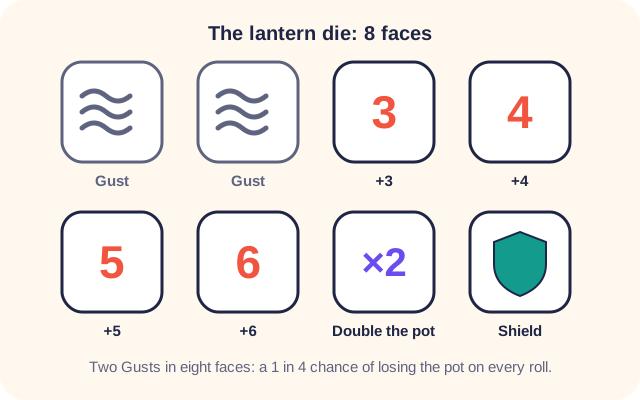
- 3, 4, 5 or 6 adds to your pot.
- ×2 Double doubles the whole pot.
- Gust blows your pot away and ends your turn, like rolling a 1 in Pig. There are two of them, so it's a 1 in 4 chance.
- Shield blocks the next Gust this turn, and you keep rolling.
The same arithmetic works here. Without a Shield, one more roll adds points on average while your pot is under about 18. A Gust is more likely than a 1 in Pig, but the Double makes big pots juicy. With a Shield up, the next Gust can't hurt you, so one more roll is always worth it on average. The first player to bank 100 wins straight away.
Play 2 to 6 people on one device, a friend online with a link, or four computer characters. Clever Cat always banks at 15, and Grandmaster Owl weighs every face of the die, beating Clever Cat about three games in four. There's also a daily Race to 100 where everyone gets the same dice: see how few turns you need.
Lucky LanternsRoll or bank? Push your luck to 100.Play freeWhy push-your-luck games are great for kids
Pig looks like a simple luck game, but it quietly teaches a lot: adding up a running total, a first feel for chance ("1 in 6"), and the very grown-up skill of stopping while you're ahead. Kids quickly argue about when to stop, and that argument is the whole lesson.
Looking for more family dice games? Try the race-and-capture fun of Race Home, explained in our Ludo-style rules guide, or practise quick sums with Math Race.
Frequently asked questions
What are the rules of the Pig dice game?
On your turn, roll one die as often as you like. Each roll of 2 to 6 adds to your turn total. Stop to add the turn total to your score, but roll a 1 and you lose the turn total and your turn ends. The first player to 100 wins.
What is the best strategy in Pig?
Keep rolling until your turn total reaches about 20, then stop. That gets the most points per turn on average. Near the end, stop as soon as you can win, and take bigger risks when an opponent is close to 100.
What happens if you roll a 1 in Pig?
You lose all the points you collected that turn and the die passes to the next player. Points you banked on earlier turns are safe.
How many players can play Pig?
Two or more. All you need is one six-sided die and a way to keep score, so it works for a whole family at the table.
Can I play a Pig-style dice game online?
Yes. Lucky Lanterns on PlayTrova is a free Pig-style push-your-luck game for 2 to 6 players, against the computer or with a friend online. No sign-up needed.