Coordinate grid games for kids: learn coordinates by playing
Coordinates click when a square's name actually matters. Here is how grid references work, a free online game to practise them, and paper games for home or class.
How grid coordinates work
A coordinate is just a name for a place on a grid. Letters run along the top, numbers run down the side, and every square gets a name made of one of each. C5 means column C, row 5. Children meet the same idea on maps, in seating plans and later in spreadsheets.
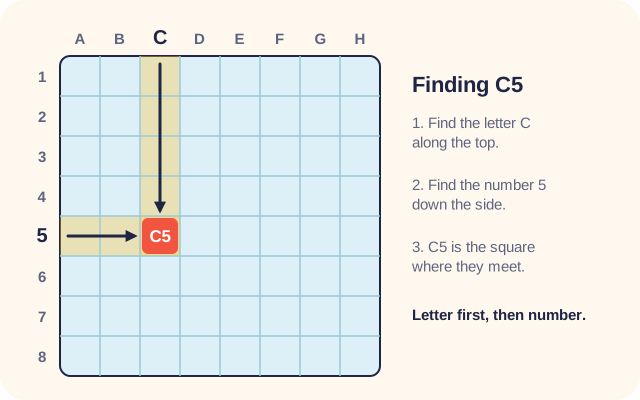
The one rule to teach is the order: letter first, then number. Say it the same way every time. The habit pays off when children move on to number coordinates, where the order really matters.
Why games are great coordinates practice
On a worksheet, a coordinate is an answer to get right. In a game it is a decision: where do I fire, what did that clue tell me, which square do I need next? Children read and say dozens of coordinates without feeling that they are practising, and a wrong square gives instant feedback, because the shot lands somewhere they didn't expect.
Short games also suit short attention spans. A few rounds a day builds the habit better than one long session.
Play online: Sea Battle
Sea Battle is our free take on the classic ship-hunting game, played on an 8×8 sea labelled A to H and 1 to 8. It runs in the browser with no sign-up, no download and no text chat.
- Every shot is named. Tap a square and the game tells you the result with its coordinate, like "C5: hit!". The row and column of the latest shot light up on the labels.
- The computer's shots are named too, so children read coordinates on their own sea as well: "They fired at D2 and missed."
- Play the computer at four levels, starting with Rookie Robo, who fires almost at random.
- Try the daily fleet. Everyone gets the same hidden ships each day, and the goal is to sink them in as few shots as possible.
- Play together. Two players can share one device, or send an invite link to play on two.
To get the most coordinates practice from it, add one simple rule: say the square out loud before you tap it. Younger players can have a parent or older sibling call the shot while they find it on the grid. Once they're confident, our Sea Battle strategy guide adds the logic side of the game.
Sea BattleFind and sink the hidden fleet before they sink yours.Play freeCoordinate games on paper
All of these need only squared paper and a pencil, and they work well at home or with a class.
- Paper ship hunt: each player draws two grids and secretly marks a few ships on one. Take turns calling squares ("B3!"), answering "hit" or "miss", and recording the results on the second grid.
- Treasure hunt: one player secretly picks a square for the treasure. The other calls coordinates and hears "warmer" or "colder" after each guess.
- Secret picture: call out a list of squares for a child to colour in. If the list is right, a picture appears, such as a heart or a rocket.
- Coordinate tic-tac-toe: play on a 3×3 or larger labelled grid, but you may only mark a square by calling its name first.
- Map my room: draw a simple grid map of a bedroom or classroom, then write clues like "the bed is at B2" for someone else to follow.
Using coordinate games in the classroom
- Class against the computer: put Sea Battle on the whiteboard. Students take turns calling a square, and the whole class checks it before anyone taps.
- Pairs on one device: two students share a tablet or Chromebook and call their shots to each other.
- Warm-up with the daily fleet: sink today's fleet together, then ask how the class could have used fewer shots.
- Early finishers: one quick game is a good reward that is still practising the skill.
Sea Battle needs no accounts, and progress stays on the device. Looking for more? See our learning games and math games for kids.
Moving on to number coordinates
Later, children meet coordinates written as two numbers, like (3, 2). The idea is the same, with two changes. Both parts are now numbers, so the order really matters: (3, 2) and (2, 3) are different points. And the numbers mark the lines, not the squares, starting from 0 in the bottom-left corner.
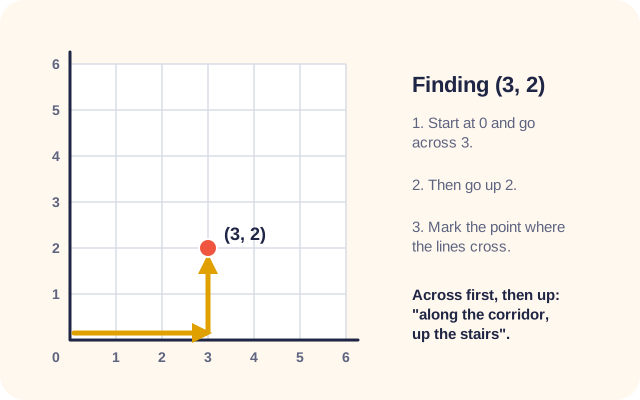
One difference is worth pointing out. On a Sea Battle grid the rows count down from the top, like reading a page. On a maths graph the numbers count up from the bottom. Point this out early so it doesn't cause confusion. The habit of "across first" carries straight over from letter-first grid references.
Common coordinate mistakes
- Swapping the order: going to row C and column 5. Practise saying "letter first" until it's automatic.
- Losing the line: a finger or ruler along the row helps on bigger grids.
- Counting instead of reading: counting squares from the edge rather than reading the labels. Point at the labels first.
- Starting too big: begin with a small grid of 4×4 or 5×5 on paper, then grow it once the idea clicks.
Frequently asked questions
What is a coordinate grid game?
Any game where players find, name or call squares on a labelled grid. The best known is the classic ship-hunting game, where you call squares like C5 to find a hidden fleet.
What age can children learn coordinates?
Many children can read simple grid references like C5 from about 6 or 7, especially on small grids. Number coordinates like (3, 2) usually come a little later. It varies by child and by school curriculum.
Does the letter or the number come first in a coordinate?
The letter comes first: C5 is column C, row 5. With number coordinates, the across number comes first: (3, 2) means 3 across, then 2 up.
Is there a free online game to practise coordinates?
Yes. Sea Battle on PlayTrova is free in your browser with no sign-up. The sea is labelled A to H and 1 to 8, and every shot is shown with its coordinate.
How do you play the ship-hunting game on paper?
Each player draws two grids and secretly marks some ships on one. Take turns calling a square. Your opponent says hit or miss, and you record it on your second grid. The first to find every ship wins.